
Money Velocity > Amount of Money
Your bank account is a very limited view of your financial health.
A common opener to a thrilling story is to put you in the middle of it without any context. The heroine is hanging off the edge of a building. A body is motionless in an empty room. The meet cute is taking place. If the creator left us with this view, we would be sorely disappointed. It is a scene that may evoke some feeling, but it tells us little about ourselves, the world or the bigger why. A good story is a clear journey that has gotten to this place and enabled us to make the future we desire.
Looking at your bank balances for financial clarity is very similar to cutting the film off with just a single scene. Your financial numbers can tell a story that gives you clarity to create the future you desire.
Along with cash on hand, a healthy business knows how the cash (or lack of it) came about and, equally important to the future, knows the cash situation to come. A few simple metrics can give a detailed picture that enables smarter action.
CASH: What’s present?
If the most important thing in the world to you were taken for ransom, do you know what you could offer (money only) immediately to get it back? You don’t have time to ask, and you don’t have time to sell; you have to rely on the financial resources you have.
Knowing cash (money that you have ready access to) is important for making decisions in the moment. It doesn’t necessarily tell you the details of how you got it, nor does it tell you what is coming your way in the future.
ACCOUNTS PAYABLE: What’s past?
Frequently, transactions happen in the moment at checkout. In business, there is oftentimes float with the terms of payment. We commit to hire someone for a service, and we pay them for it in installments. We sign a contract to fabricate a complex object for our work, and we pay them when certain stages of development have occurred. The payments we commit to make in the future are known as accounts payable. Knowing how much we owe to others gives us a greater idea of how much of the cash we see in the bank is actually ours.
ACCOUNTS RECEIVABLE: What’s future?
Similar to what we must pay to other people, there is a good chance we are signing deals that have terms for payment. We may not like the delay, but it oftentimes helps deals get done and gives other parties greater confidence in the process. The amount of funds to be paid to us in the future are our accounts receivable. They can tell us more about our financial trajectory than cash on hand.
NET MONEY: What action’s next?
Awareness of cash, payables and receivables can tell us a lot about what is to come and what we need to do in order to get there. Do we have the funds to pay our landlord next week? Will we be able to purchase the materials for the project next month? Can I spend more time in the studio on a creative self-project? Knowing when money will move into and out of our accounts makes deciding what to do today easier and with less (or more) stress.
If you desire to get beyond the opening scene of your finances, it will take more than just looking at your bank accounts. A few simple metrics can give you more of a story to engage and act upon.
If numbers are not your thing, don’t worry; that is why the agency and many other businesses exist. We offer support for free through our free virtual professional development sessions, and, of course, we always welcome you to our table for a coffee to chat about what it will take to sustain your creative practice.
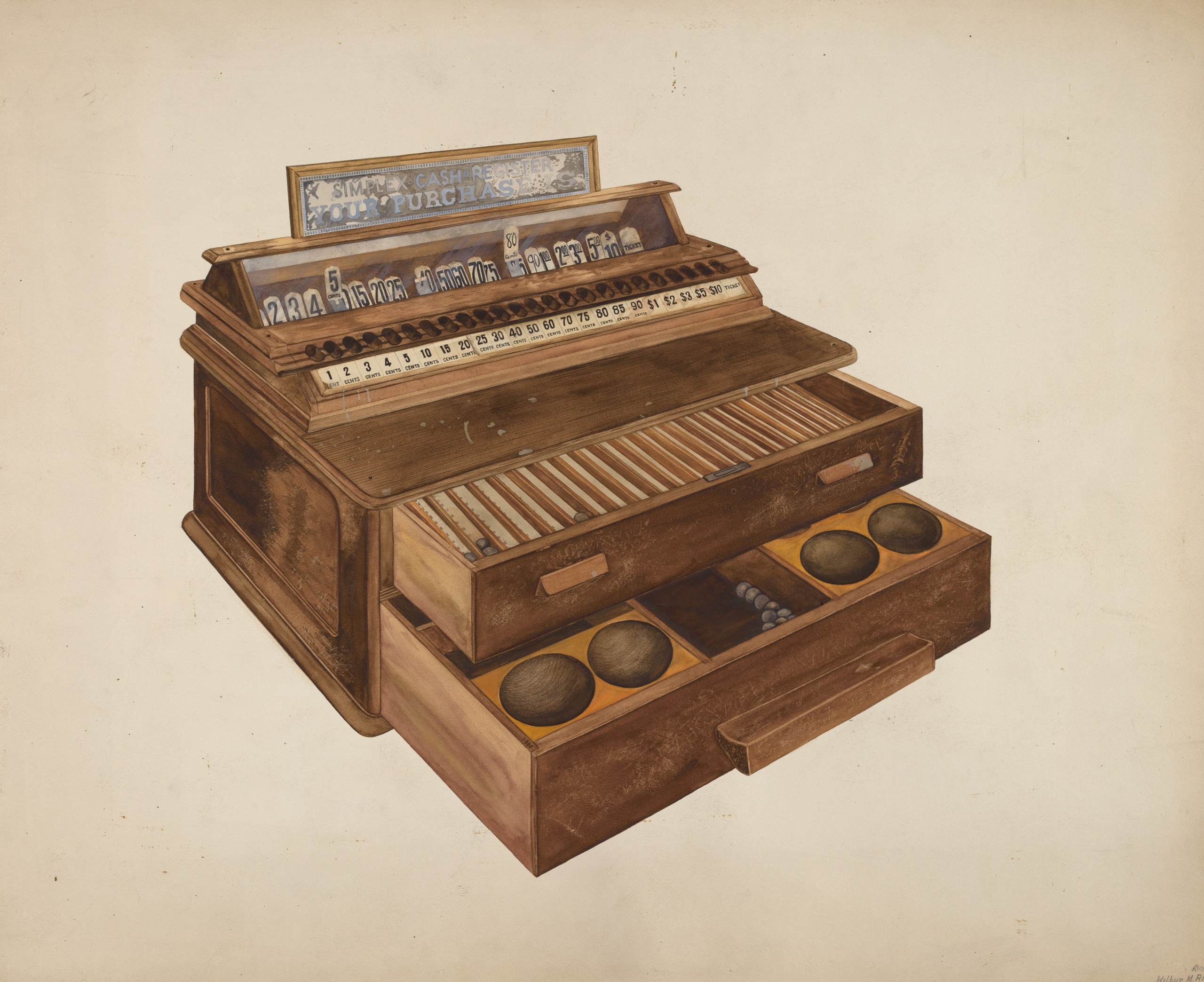
Banner Art Credits: Wooden Cash Register (c. 1942), by Wilbur M. Rice, gives us a fitting image: the humble, handmade tool for organizing a complex flow. It is less a symbol of wealth than an instrument of awareness. Financial health begins not with excess or fantasy, but with seeing what is in hand, on the way, spoken for, and what happens next. (Index of American Design; National Gallery of Art Open Access/public domain.)